


AI for Real Estate Lead Generation: Top 6 Tools & Use Cases [2026]


I tested and reviewed how AI for real estate lead generation can help teams get more leads quickly and stay on top of follow-ups. From all the tools I tested, these are the top 6 that delivered value and are worth checking out.
Why realtors use AI for real estate lead generation
Realtors use AI for real estate leads to respond faster, follow up consistently, and keep conversations relevant until a deal closes. Most teams adopt AI because lead volume grows faster than a human can manage alone.
Here are the reasons why realtors use AI:
- Leads arrive faster than agents can respond: Most teams generate enough leads. The problem starts after the inquiry comes in. AI replies instantly, asks basic questions, books appointments, and logs everything into the CRM. Speed-to-lead decides whether a conversation starts.
- Manual follow-up causes deals to stall: Buyers rarely convert after one message. AI runs consistent follow-ups across email, text, and voice based on timing and behavior. This keeps leads warm and pulls conversations back before interest fades.
- Agents need clarity on who to call next: AI scores leads using engagement signals like listing views, replies, and activity. Agents stop guessing and focus on people who show real intent today.
- Personalized messages get replies: Generic outreach fails. AI tailors follow-ups based on what buyers actually do, such as the listings they view or preferences they mention. It gives agents context before the conversation begins.
- Buyer behavior no longer follows a schedule: Buyers browse late, abandon forms, and return without warning. AI tracks these patterns and nudges leads at the right moment, bringing agents in when timing matters.
Real estate teams use AI because the old way of working cannot keep up with buyer expectations or response speed. AI handles the repetition so agents can focus on closing.
Top 6 AI tools for real estate leads: TL;DR
I tested each platform to see how well they support AI lead generation for real estate workflows. Here’s how they stack up against each other:
1. Lindy: Best real estate AI lead generation tool overall
What it does: Lindy gives you ready-to-use AI agents that can generate leads for real estate, qualify them, book appointments, handle calls, and update your CRM automatically.
Who it’s for: Solo agents and teams that want consistent lead response and follow-up without hiring more staff or changing how their pipeline already works.
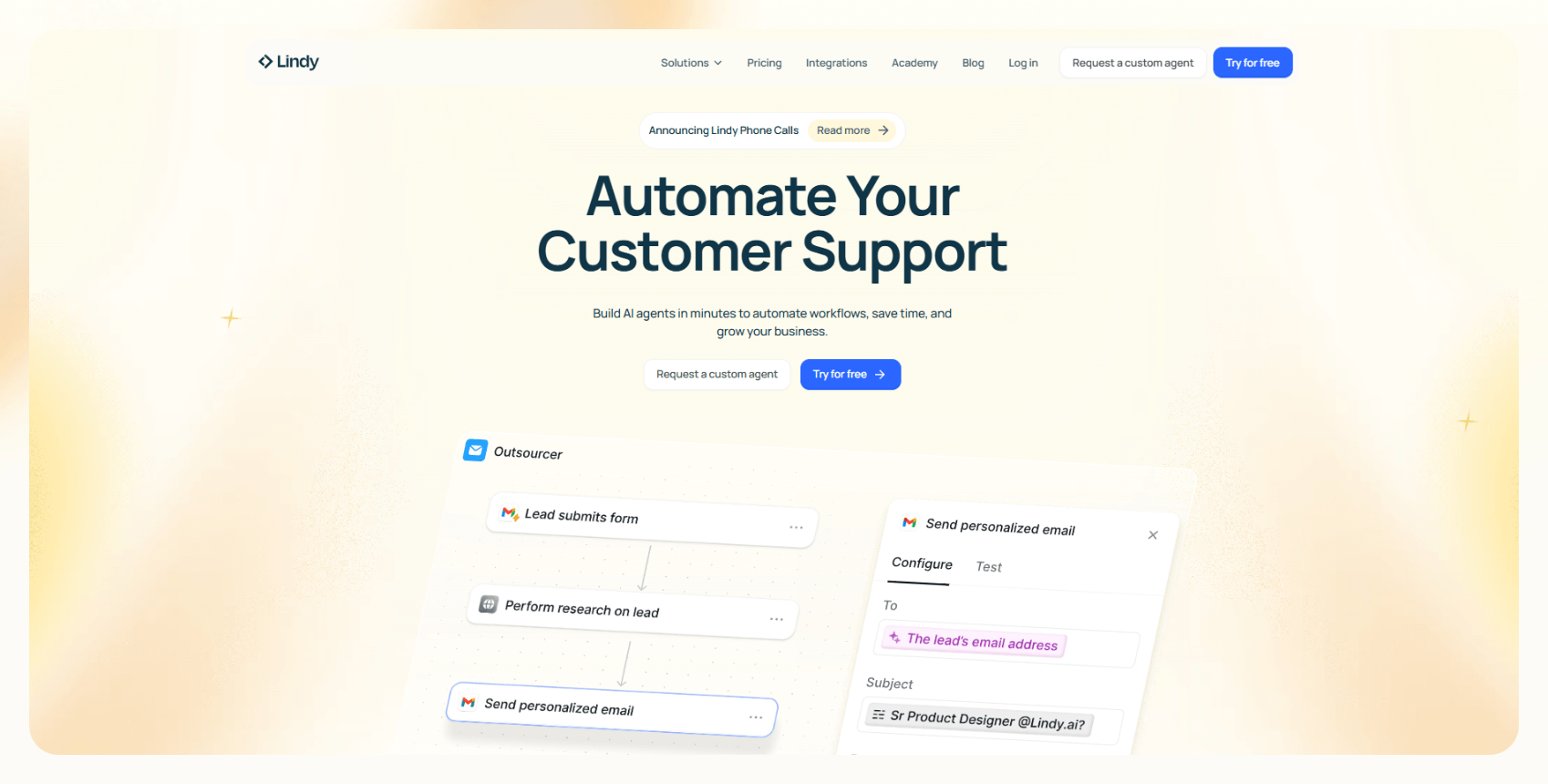
Lindy can handle real estate lead generation end-to-end, not just isolated tasks. During testing, I used it to respond to new inbound leads, return missed calls, ask qualification questions, and route qualified prospects to the next step automatically.
I set up multiple agents inside a single workflow. One agent captured new leads as they came in, another qualified buyers or sellers over text or call, and a third updated the CRM and scheduled follow-ups.
Each agent shared context across the workflow, so handoffs stayed smooth throughout the day. Everything ran in parallel, which kept response times fast and conversations organized.
My test workflow adapted to different lead sources, timing, and conversation paths without breaking. Once configured, the AI handled routine interactions, and I only stepped in when judgment or nuance mattered.
Lindy also connected with my existing CRM, calendar, and inbox. With access to over 4,000 integrations, it pulled the data, updated records, and kept systems in sync without forcing changes to how leads already moved through the pipeline.
Leads flowed in, conversations stayed organized, and CRM updates happened automatically in the background. That autonomy is what makes it effective and lets you do more than just generate leads without increasing headcount.
Key features
- Ready-to-use and customizable lead generator template
- Voice, email, and SMS agents that hold full conversations and take action after each one
- No-code workflow builder for custom qualification and follow-up paths
- 4,000+ integrations with Salesforce, HubSpot, Pipedrive, and other business tools
- Calendar support for scheduling showings and intro calls
- Call logging and summaries are added to the CRM automatically
- Webhook support for custom tools and internal systems
- 30+ languages for calling and messaging
- Human-in-the-loop review for high-value or sensitive conversations
Pros
- Responds instantly to new leads across multiple channels
- Templates for enrichment, qualifying, meetings, email, and more
- Quick and easy setup
- Scales without additional assistants or sales development representatives
- SOC 2 and HIPAA compliance to protect data and privacy
Cons
- Setup can take time when the lead flow or logic is complex
Pricing
- Free plan with up to 40 monthly tasks
- Paid plans start from $49.99/month, billed monthly
Bottom line
Lindy works well for real estate teams that want AI to manage the high-volume, repetitive parts of lead generation while keeping the human conversation.
It fits easily into AI real estate lead generation setups where speed and consistency matter, while saving time and keeping leads warm.
{{templates}}
2. Ylopo: Best for paid ads and long-term lead nurture
What it does: Ylopo generates real estate leads through paid ad campaigns and nurtures them with its AI tools and behavioral triggers based on engagement on its IDX websites.
Who it’s for: Teams that rely on paid ads and want automated text follow-up without tracking buyer activity beyond their own sites.

I tested Ylopo in ad-driven lead generation workflows where traffic volume and long-term nurture matter more than instant qualification. It performs well at the top of the funnel.
Leads flow in through Facebook and Google ads, land on branded IDX sites, and enter automated text conversations shortly after.
Ylopo does not track buyer behavior across the web. Instead, it monitors engagement only on its IDX sites, such as listing views and saved searches. The AI assistant responded only to clear on-site signals, which suits teams that prefer stricter compliance boundaries.
The AI texting assistant uses these signals to pace outreach naturally. It follows up when interest appears and eases off when activity drops.
Ylopo works best alongside a separate CRM, handling lead capture and nurture while other tools manage qualification and pipeline tracking.
Key features
- Paid advertising across Facebook, Instagram, and Google
- Branded internet data exchange (IDX) home search sites
- An AI texting assistant that replies to new leads
- Behavioral tracking and alerts for high-intent activity
- Integrations with CRMs such as Follow Up Boss and Sierra Interactive
Pros
- Strong ad performance paired with automated nurture
- Helpful for keeping cold leads engaged over long timelines
- Solid branding and listing visibility
Cons
- Pricing is not listed publicly
- Requires a separate CRM for full lead management
Pricing
- No free plan
- Paid plans require a custom quote
Bottom line
Ylopo is a good choice for teams that generate leads through paid channels and need an AI assistant to keep those leads warm over time. It supports top-of-funnel growth and helps agents stay present without manually replying to every new inquiry.
3. Offrs: Best for identifying likely sellers early
What it does: Offrs identifies likely home sellers by applying advanced data analytics to public records, historical sales trends, and third-party data to generate predictive seller scores.
Who it’s for: Agents and teams that focus on listings and want earlier seller conversations in specific zip codes.
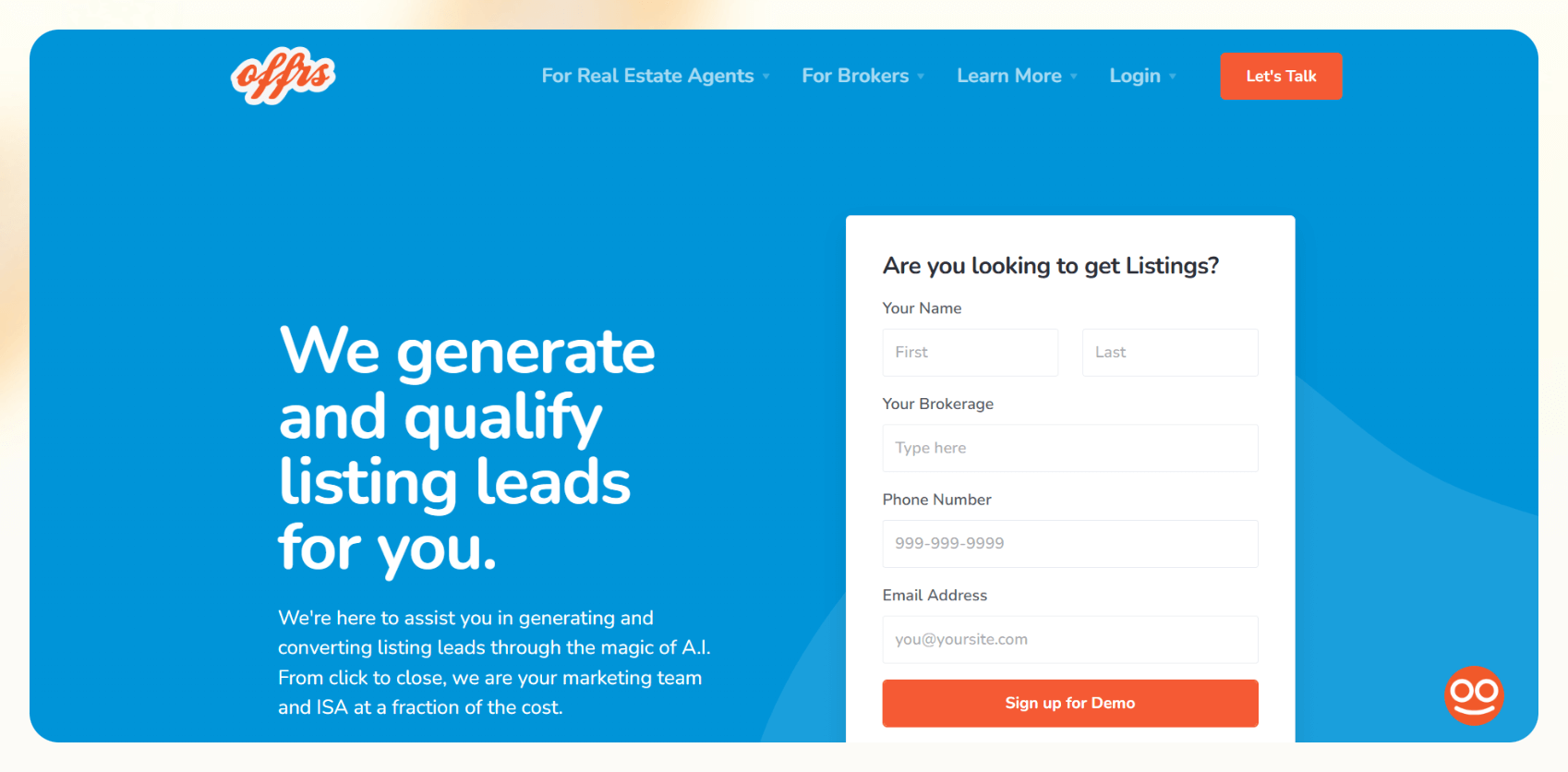
I tested Offrs in workflows where the goal is to spot potential sellers before they raise their hand. The platform delivers daily lists of homeowners ranked by likelihood to sell, which gives agents a starting point for outreach instead of cold guessing.
I found Offrs useful in markets with strong data coverage. The predictions felt more reliable in active, data-rich areas and less consistent in rural or low-volume markets. That variation matters, especially for agents who work across mixed territories.
Offrs does not manage follow-up or conversations. It surfaces opportunities, then relies on the agent’s own process to act on them. This makes it a good fit for teams that already have outreach systems and want better inputs at the top.
For real estate AI lead generation on the seller side, Offrs adds value by narrowing the list of who to contact. It does not replace prospecting work, but it helps agents start conversations earlier and with better timing.
Key features
- Predictive seller scoring using more than 250 data points
- Daily updates on potential sellers by zip code
- CRM and marketing integrations
- Exclusive territory options to reduce competition
Pros
- Strong fit for listing-focused agents
- Helps uncover off-market opportunities early
- Performs well in data-rich urban areas
Cons
- Accuracy varies depending on the market
- Limited control over how follow-up happens
Pricing
- No free plan
- Paid plans require a demo scheduling
Bottom line
Offrs is a helpful tool for identifying likely sellers before they appear on the multiple listing services. If you want earlier conversations and more listing opportunities, it gives you the data to reach the right homeowners first.
4. Revaluate: Best for reviving cold leads in your CRM
What it does: Revaluate predicts which contacts in your CRM are most likely to move by analyzing third-party data, modeled signals, and consumer behavior.
Who it’s for: Agents and teams with large CRMs who want to prioritize outreach without buying new leads.

I tested Revaluate in workflows where databases had gone cold but still held long-term value. Revaluate looks for inferred move signals across external data sources and behavioral patterns. These signals update daily and reshuffle which contacts deserve attention.
This approach felt practical and less intrusive. The platform did not rely on explicit life events. It highlighted contacts who showed shifting behavior that often precedes a move.
Revaluate does not handle messaging or follow-up. It works as a prioritization layer that sits on top of your CRM. Agents still control outreach, scripts, and timing.
Revaluate adds value by turning an old database into a focused call list. It does not create new demand, but it helps agents re-engage the right people at the right time.
Key features
- Daily predictive scoring for existing leads and contacts
- AI move-likelihood model that updates automatically
- Integrations with major CRMs
- Connects with email and outbound tools for follow-up
Pros
- Helps uncover hidden opportunities in older lead lists
- No need to buy new leads
- Simple, set-it-and-forget-it scoring model
Cons
- Works best when you have a large CRM or long-standing database
- No built-in follow-up or communication tools
Pricing
- No free plan
- Paid plans require a custom quote
Bottom line
Revaluate helps you revive older leads that still show potential. If your CRM is full of contacts who have gone quiet, this tool helps you see who might be ready to talk again.
5. CINC: Best platform for high-volume teams
What it does: CINC generates real estate leads through Google and Facebook ads, captures them on IDX websites, and manages follow-up through its built-in CRM and AI texting assistant.
Who it’s for: Established teams and brokerages that run high lead volume and want one system to manage ads, routing, and follow-up.
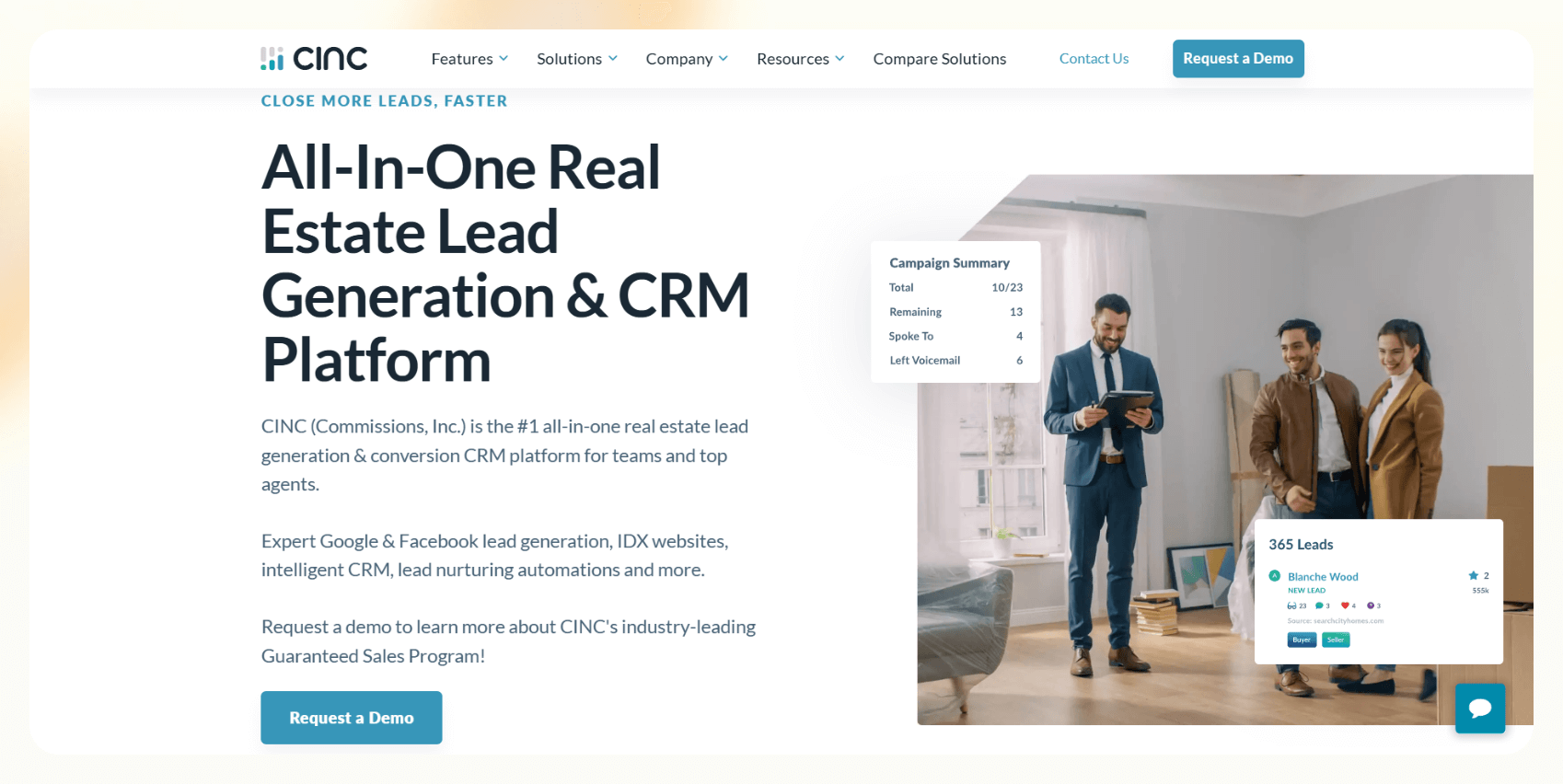
I tested CINC in team-based lead generation workflows where structure and volume matter more than flexibility. It performs well as a centralized system. Leads flow in from paid ads and IDX sites, route to the right agents, and enter follow-up sequences without manual setup.
CINC’s AI texting assistant, Alex, handles basic outreach and activity-based follow-ups. It worked reliably for early engagement and simple responses. It supports the process, but it does not replace human judgment when buyers ask detailed questions or shift direction.
CINC includes many features beyond lead generation, which can feel heavy for smaller teams. It works best when teams want control, visibility, and consistent execution across dozens or hundreds of leads.
Key features
- Branded IDX websites and landing pages for lead capture
- Paid ad campaigns through Google and Facebook
- AI texting assistant for automated nurture
- Built-in dialer and mobile CRM app
- Lead routing, activity tracking, and team management tools
Pros
- Covers the complete lead lifecycle from capture to conversion
- Strong automation for follow-up
- Works well for large teams handling heavy lead volume
Cons
- More features than solo agents typically need
- Setup and pricing can be on the higher end
Pricing
- No free plan
- Custom quote after requesting a demo
Bottom line
CINC works for teams that want one system to manage everything from ads to follow-up. If you run a busy pipeline and need structure, automation, and team-wide visibility, CINC brings it all under one roof.
6. ChatGPT: Best for scripts, writing, and quick content support
What it does: ChatGPT helps real estate agents draft emails, texts, scripts, and marketing content on demand.
Who it’s for: Agents who want help with writing and idea generation rather than full lead automation.
I tested ChatGPT for tasks such as writing follow-up texts, listing descriptions, objection-handling scripts, and nurture emails. It speeds up writing when you give it clear direction and examples.
However, the output quality depended on my prompts. Simple requests produced generic drafts. Detailed instructions led to usable copy that still needed edits. ChatGPT worked best as a drafting assistant, not a finished output.
ChatGPT also lacks real estate context out of the box. Agents still need to apply local knowledge, compliance checks, and tone adjustments. It adds speed, but not judgment.
ChatGPT supports the work around conversations rather than running them. It helps agents write faster and stay consistent, but it does not replace tools that handle response timing, scoring, or follow-up.
Key features
- Creates emails, texts, scripts, and other content quickly
- Available through the web or integrated into other tools
- Custom instructions for tone and style
- Can support brainstorming and idea generation
Pros
- Helps agents write faster and with more consistency
- Easy to use across different tasks
- Low-cost way to produce scripts and content
Cons
- Not purpose-built for real estate
- Requires clear prompts to produce good results
Pricing
- Free plan available
- Paid plans start from $20/month, billed monthly
Bottom line
ChatGPT is a helpful assistant for writing and content creation. If you want support with scripts, messages, or marketing ideas, it offers flexibility without needing a full real estate platform.
Use cases for AI in real estate lead generation
Real estate teams use AI for more than quick replies, but not every use case matters for lead generation. The value shows up where AI helps agents respond faster, prioritize better, and keep conversations moving until a decision happens.
These are the use cases that directly support real estate lead generation:
Lead scoring that shows who is ready to move
Most teams waste time treating every lead the same. AI changes that by scoring leads based on behavior instead of guesswork.
It looks at listing views, saved searches, email opens, replies, call activity, and engagement patterns. When someone views multiple properties or revisits a search, the system pushes them up. When someone goes quiet, they move down.
AI for realtors can highlight which lead needs attention today. This helps agents spend time on intent, not volume. Tools like Revaluate also bring older leads back into view when behavior shifts, which turns cold databases into active pipelines again.
Personalized follow-ups based on buyer behavior
Generic messages rarely convert. Buyers respond when outreach reflects what they care about. AI supports this by tracking behavior and suggesting relevant follow-ups. If a buyer keeps checking modern homes in one area, messages reflect that interest. If they mention a home office, future outreach includes it.
This context helps agents start conversations without guessing. It increases reply rates and shortens the gap between interest and action.
Chatbots and virtual assistants that capture intent early
Many buyers prefer a quick interaction instead of a long form. AI chatbots and virtual assistants meet them there.
They ask simple questions about budget, buying or renting, and preferred locations. Based on the answers, they share listings, schedule showings, or pass the lead to an agent. Phone-based AI agents follow the same logic and respond even when teams are unavailable.
This early interaction reduces drop-offs and captures intent while it’s fresh.
Automated follow-ups that prevent lead drop-off
Most deals stall because follow-up stops too soon. AI keeps conversations alive without relying on memory. It sends messages based on behavior and timing. Missed calls trigger a text. Opened emails trigger reminders. Viewed listings trigger relevant suggestions.
These touches feel timely and natural, not forced. Consistent follow-up brings more leads back into motion without adding work.
Lead enrichment that gives agents context before outreach
AI also fills in missing details using public data and activity signals. Agents see timelines, household context, and engagement patterns before a call. That context removes friction and helps agents guide conversations faster.
In real estate lead generation, that consistency is often the difference between a cold lead and a closed deal.
AI helps teams stay consistent where humans fall behind. In real estate lead generation, that consistency is often the difference between a cold lead and a closed deal.
How to use AI for real estate lead generation
Understanding how to use AI in real estate starts with spotting the places where your pipeline slows down. You do not need to automate everything at once. Follow these steps for a smooth setup:
Step 1: Evaluate where your pipeline breaks
Every agent has a different sticking point. Solo agents often need help with follow-ups or late-night inquiries. In that case, a single AI agent or a writing assistant might be enough.
Larger teams struggle with call volume, inconsistent routing, CRM updates, or qualification. They need broader coverage across calls, texts, email, and backend tasks.
Look at where momentum drops. That is your starting point. When you know how to use AI for real estate at each stage, the setup feels much simpler.
If your team spends most of its time chasing cold leads, begin with scoring. If you lose leads after the first message, begin with an automated follow-up.
When new inquiries slip through in busy hours, start with AI phone or chat agents.
Step 2: Choose tools that match how you work
Most agents do not need ten platforms. They need one or two that fit their workflow cleanly. Here are a few things to look for:
- CRM integration so the AI updates contacts without manual work
- Human review for high-value leads or nuanced situations
- Multi-channel support for calls, email, and text, depending on where your leads appear
If the tool also provides summaries, recordings, or scoring, that adds clarity later without extra effort.
Step 3: Onboard slowly and experiment
Start with a simple workflow. For example, build one AI agent that replies to new website leads and books a call based on your availability. Teach the agent what to ask, how to qualify someone, and when to hand it off.
Test it in low-stakes situations, refine the responses, and adjust the script as you learn.
Upload your FAQs or listing details to give the AI context. Review the conversations each week and adjust your qualification rules. It does not need to be perfect on day one. It only needs to save you time and reduce the daily pressure.
Here are a few tips I wish I had known earlier to get more out of AI:
- Use call summaries to refine your script
- Let scoring guide your daily outreach
- Check your messaging for compliance
- Create separate workflows for buyers, sellers, and renters
Small changes in your setup can create the biggest efficiency gains. Once you see what works, you can expand your AI coverage slowly.
{{cta}}
Try Lindy’s AI for real estate lead generation
If you want to stop chasing every lead manually, Lindy’s AI for real estate lead generation can help. It delivers curated lead lists, updates your CRM, and even handles follow-ups, so your team can focus on building relationships, not spreadsheets.
Here is what makes it useful for real estate teams:
- Drag-and-drop workflow builder for non-coders: You don’t need any technical skills to build workflows with Lindy. It offers a drag-and-drop visual workflow builder.
- Create AI agents for your use cases: You can give them instructions in everyday language and automate repetitive tasks. For instance, create an assistant to find leads from websites and sources like People Data Labs. Create another agent that sends emails to each lead and schedules meetings with members of your sales team.
- 24/7 agent availability for async teams: You can set Lindy agents to run 24/7 for round-the-clock support, perfect for async workflows or round-the-clock coverage.
- Add Lindy to your site: Add Lindy to your site with a simple code snippet, instantly helping visitors get answers without leaving your site.
- Personalized email outreach and replies: Lindy’s Lead Outreacher crafts personalized outreach and manages replies autonomously. Your team can send professional replies without hours of manual effort.
- Lead enrichment: You can configure Lindy to use a prospecting API to research prospects and to provide sales teams with richer insights before outreach.
Frequently asked questions
What is the best AI for real estate lead generation?
Lindy is the best AI for real estate lead generation because it can automatically handle new inquiries, qualify buyers and sellers, and book appointments. It works across voice, email, and text, which gives agents consistent coverage at all hours.
How do real estate agents use AI to get more leads?
Real estate agents use AI to get more leads by responding to new inquiries, qualifying buyers and sellers, and keeping follow-ups consistent. AI also tracks behavior, scores leads, and sends messages when someone shows intent.
Can AI help with real estate lead follow-up?
Yes, AI can help with real estate lead follow-up by sending timely messages through email, text, or voice after someone shows interest. It reacts to what leads do and keeps conversations active until the agent steps in. This support prevents missed opportunities.
Is AI worth it for solo real estate agents?
Yes, AI is worth it for solo real estate agents because it handles repetitive work like replying to new leads, booking showings, and running follow-ups. It saves time and helps agents stay consistent even when they manage everything on their own.
Can AI replace real estate agents?
No, AI cannot replace real estate agents. Human judgment, creativity, and negotiation skills are essential to build relations and convert leads. AI can support early conversations, scoring, and follow-ups, and handle repetitive work so agents can focus on the parts of the job that require expertise.








Blog
Related Articles
%2520(1).png)

%20(1).png)
%20(1).png)
.png)
%2520(1).png)
The AI assistant that runs your work life
Lindy saves you two hours a day by proactively managing your inbox, meetings, and calendar, so you can focus on what actually matters.
