


What is an AI employee? A guide to the 2026 digital workforce


In early 2026, a founder I know cut his entire admin stack down to one tool. He dropped his virtual assistant, his scheduling app, his CRM updater, his meeting notes software, and the social media scheduler he'd been paying for since 2023. Replaced all of it with a single AI employee tool.
At first, I thought he was exaggerating, but then he showed me his calendar. Three months of meetings, follow-ups, and lead research, handled while he slept.
I spent the next eight weeks testing 13 AI employee platforms. I ran them through real workflows, including outbound sales, customer support, inbox triage, and operations.
Some worked, while others were chatbots dressed up with better marketing. Most fell somewhere in between. This guide covers what AI employees are, how they work, and the 8 tools worth using in 2026.
Let's get into it.
What is an AI employee?
An AI employee is a software-based assistant that can handle your work on its own. It uses AI to complete multi-step tasks, make decisions, and adapt as it learns without needing constant input. Think of it this way: a chatbot is a reference book, but an AI employee is someone you’ve onboarded into the role.
So why use an AI employee?
Most AI tools are reactive. You ask a question, they answer it. You paste in text, and they rewrite it. It's useful, sure, but you're still the one guiding it every step.
An AI employee works the other way.
You give it a role like "handle inbound support tickets" or "research and reach out to new leads", and it runs that function on its own. A new ticket comes in at 2 am. It reads the request, pulls an answer from your knowledge base, and sends a reply. You wake up to resolved tickets and not a pile of unanswered questions.
Some of the common things a good AI employee can do:
- Email triage and drafting
- Research and reporting
- Full multi-step workflows
- Meeting scheduling and prep
- Customer support and ticket routing
- Outbound prospecting and follow-up
What they don't replace is judgment in ambiguous situations, relationship-building, and creative work that requires original thinking. The best AI employees know when to act and when to hand off to a human.
How I tested these AI employees
To test these AI tools, I followed a three-step process. First, I signed up for each platform and ran it against real work, actual tasks I needed done, not just demo scenarios.
Then I went to Reddit, and that's where I learned the most.
People on Reddit will tell you the tool broke after three weeks, that the pricing changed without warning, or that support ghosted them. I cross-referenced those threads with G2 reviews to spot patterns, because if the same issue kept popping up, it’s probably not a one-off.

I tested every tool against the same set of factors. It's the only way to spot where one genuinely pulls ahead, rather than just being good at something nobody else has been tested on.

Some tools didn't make the cut for clear reasons. Beam AI had some solid ideas, but the onboarding felt too hands-on for most teams to stick with.
AgentGPT just wasn't consistent enough with multi-step tasks to rely on for real work. Relevance AI looked promising but required too much technical setup before it did anything useful. Adept felt early, impressive in demos, but not reliable enough in practice to recommend with confidence.
And Zapier Agents handled simple triggers well, but fell short the moment tasks needed real judgment across multiple steps.
Lastly, here's how these 5 tools landed in my rating table:
Here's how these 5 tools landed in my rating table. (Eesel AI, Sintra, and Supervity rounded out the list but served narrower use cases)
How does an AI employee work?
An AI employee works by connecting to your tools, learning your rules, and taking action on its own whenever something triggers it. The good ones pull context from your data and execute tasks across apps without requiring manual input each time.
Here’s the step-by-step process:
- Connecting your tools: An AI employee plugs into the software you already use. Your inbox, CRM, calendar, Slack, support platform. Before it can do anything useful, it needs visibility into what's happening in your business.
- Assigning a role with context: This is basically onboarding. You tell it which functions it owns, which rules it follows, and what it should escalate versus handle on its own. The better platforms let you set guardrails so it never takes an action you haven't approved for that category.
- Monitoring triggers: A new email arrives. A lead submits a form. A deal hasn't been updated in five days. A support ticket comes in marked urgent. These events automatically kick off action; no manual check required.
- The AI employee acts: Once a trigger fires, the AI employee completes the task end-to-end. It drafts, sends, books, logs, routes, or escalates, depending on the situation. It handles the full job, not just the first step.
- Your AI employee improves over time: The best platforms adapt to your preferences. They learn your writing style, which leads you to prioritize the response types you approve without changes. The longer it runs, the less you need to review.
1. Perplexity Computer: Best for multi-agent projects and research
What is it: Perplexity Computer is a cloud-based AI system that does the actual work. Give it a project, it plans the workflow, spins up sub-agents, and delivers results while you focus on something else.
Best for: Teams and professionals running deep research, multi-source reports, dashboards, and content projects that would otherwise take days to pull together manually.
Features:
- Runs in a secure cloud sandbox
- Handles weeks-long ongoing projects
- Multi-step project planning from a single prompt
- Creates parallel sub-agents for faster execution
- Connects to Google Drive, Slack, Salesforce, and Notion
- Orchestrates 19 AI models, including Claude, Gemini, and GPT

Why I picked it
I've wasted more hours than I'd like pulling together competitive analyses tab by tab, copying data into a doc, and repeating the whole thing whenever something updated. That's exactly the problem Perplexity Computer is built to solve.
You describe the output you want, and it breaks the project into parallel tracks, routing each piece to the right model automatically. Research goes one way, code another, image generation a third. Instead of managing tools and steps yourself, you just review the results and move forward.
I’d only ask you to be specific with your prompts. If you’re vague, you’ll end up going back and forth, rephrasing the same thing while trying to set up Perplexity.
But when you give it a clear start and end point, "pull churn data from these three sources and summarize the top three causes" versus "help me understand churn," the quality difference is significant. That is not a limitation if you expect near-ideal results.
My friend likes using Perplexity because you can really see how it’s working. There’s enough transparency to follow the process step by step.
Even when I ran a competitive analysis through Perplexity, it flagged two sources it couldn’t verify, rather than just filling in the gaps. For research where accuracy matters, that’s a bigger deal than most tools admit.
Limitations
Credit costs scale fast on complex tasks, which means irregular users will burn through their allowance quickly. It also does not touch files on your local machine, so workflows that depend on local storage hit a wall.
And at $200 per month, casual users will struggle to justify the price until they have a consistent, high-volume research workload to run it against.
Pricing
Perplexity Pro costs $20/month and includes access to Perplexity Computer, the latest AI models, and deeper sourcing from PitchBook, Wiley, and more. New subscribers also get $20 in Computer credits for free on signup. For teams that need more, Enterprise Pro starts at $34/seat per month and Enterprise Max at $271/seat per month, both billed annually.
2. Marblism: Best for scaling businesses with expert teams
What it is: Marblism is a YC-backed platform that gives you six specialized AI employees. Each comes with a defined role, covering everything from inbox management and sales outreach to SEO content, social media, phone reception, and legal contract review.
Best for: Solo founders, bootstrapped startups, and small teams spending 20-plus hours a week on admin work who need to scale output without scaling headcount.
Features:
- AI inbox and calendar management (Eva)
- Social media content and scheduling (Sonny)
- Contract review and legal risk flagging (Linda)
- SEO blog writing and CMS publishing (Penny)
- Cold email outreach with 700M lead database (Stan)
- AI phone receptionist with call transfers and booking (Rachel)

Why I picked it
When tackling everything yourself, at times, outreach slips, content stalls, and your inbox piles up. That’s exactly why Marblism hands you a team of six AI employees, each with a defined role, clocked in and running their function while you focus on the work only you can do.
The first three cover your internal operations.
Eva, the executive assistant, categorizes emails, drafts replies in your writing style, and manages your calendar. Stan, the lead generation agent, taps into a 700+ million-lead database and runs personalized cold email outreach and follow-ups while you focus on closing.
And Rachel, the AI receptionist, answers your business calls, books appointments, and handles call transfers across US, CA, and UK numbers.
The remaining three cover your external presence.
Penny researches keywords, generates full SEO-optimized blog drafts with images, and publishes directly to WordPress, Wix, or Shopify without you touching a brief. Sonny manages your social media presence across LinkedIn, Instagram, and Facebook, creates posts and images, and can be set to autopilot to schedule a fixed number of posts every week.
And then there's Linda, the legal assistant, who reviews contracts, breaks down complex jargon into simple English, and flags anything unusual before you sign.
Between the six of them, a meaningful chunk of your week just drops off your to-do list.
And what I like about Marblism is that it removes prompt engineering from the equation. The role-specific logic is built in, so it’s easy to get started without overthinking.
Limitations
Marblism isn’t something you can just set up and forget. You’ll still need to review what it sends, especially to catch tone issues or simple misses, like reaching out to someone who’s already been contacted. It also struggles with more complex workflows. If your process involves multiple conditions or edge cases, it can feel a bit limited.
And on the admin side, there’s not much in terms of permissions or compliance, so it’s not the best fit for larger teams.
Pricing
Marblism offers a single plan with three billing options. Pricing starts at $24/month on the yearly plan, $33/month on the quarterly plan, and $44/month on the monthly plan. All plans include access to all six AI employees and unlimited tasks.
3. Claude: Best for advanced reasoning and coding
What it is: Claude is an AI assistant built for advanced reasoning, coding, and multi-step work. Give it a complex outcome, and it plans, executes, and delivers without you having to manage every step. It works across your files, runs code, and connects to the tools you already use.
Best for: Developers, operators, and knowledge workers who need an AI that can touch real files, run code, and handle multi-step projects that are too complex for a chatbot to finish in one go.
Features:
- Scheduled tasks on a set cadence
- Spawns parallel sub-agents for complex projects
- Persistent memory across sessions via local files
- Reads and writes directly to your local file system
- Runs code and shell commands in an isolated VM
- Connects to Gmail, Slack, Notion, and Google Drive

Why I picked it
Most people use Claude as a chatbot, and that works fine for quick tasks. But the moment a project gets complex, that back-and-forth loop becomes the issue. You're spending more time prompting than working.
Claude Cowork removes that loop entirely. You describe the outcome you want, and it builds a plan, breaks it into parallel tracks, and executes each one independently. Like a real assistant, Cowork goes through your internal knowledge system and works accordingly.
For example, Cowork can open a folder, edit a document, update a spreadsheet, or save outputs right where you’d normally keep them. It works directly on your local files, and no copies or extra steps are involved.
I use Cowork to put together a daily digest before I start work. It goes through my files, recent notes, and ongoing docs, then pulls together a quick brief of what matters that day. It highlights anything pending, updates I might’ve missed, and what needs attention next.
That’s when I noticed it was actually storing my preferences locally. After a few edits and corrections, it started picking up my structure and priorities on its own.
Projects let you group tasks into separate workspaces, each with its own files, context, and memory, so nothing bleeds into something else. And if you're away from your desk, you can message Claude from your phone, and the work still runs on your desktop. You just don't have to be sitting in front of it.
Limitations
At times, Claude can be slow, occasionally buggy, and compute-intensive enough to consume usage tokens faster than standard Claude. The app also needs to stay open, and your computer needs to stay awake for tasks to run. If you close it mid-task, everything stops. For teams running intensive workloads, the jump to Premium seats at $125/person/month adds up quickly.
Pricing
Claude has a free plan, but getting the most out of it as an AI employee requires a paid subscription. Pro starts at $20/month and includes access to Cowork. Max starts at $100/month and gives you five to twenty times more usage than Pro, which matters for compute-heavy tasks. For teams, standard seats run $25/month, and premium seats run $125/month, with premium seats offering five times as much usage as standard seats.
4. Motion: Best for scheduling and task management
What it is: Motion is an AI work platform that auto-schedules your tasks, manages your team's calendar, and deploys role-specific AI employees to handle recurring business operations, without you micromanaging the day.
Best for: Service-based businesses, agencies, and high-performance teams that need their projects, tasks, calendars, and AI employees to live in one place.
Features:
- Meeting orchestration via Alfred
- SOP automation through AI Workflows
- Dynamic Gantt charts that update in real time
- Auto-schedules tasks directly onto your calendar
- AI Project Manager (Millie) predicts deadlines and spots risks early
- Role-specific AI employees for sales, marketing, support, and recruiting

Why I picked it
Instead of scanning a long to-do list and deciding where to start, Motion auto-plans your day by slotting tasks directly onto your calendar based on priorities and deadlines.
Millie, the AI project manager, goes a step further. AI schedules work across your entire team, predicts when projects will finish, and flags deadline risks before they become actual problems. I've seen teams describe it as having an executive assistant who never drops a thread.
Then, the AI employee Chip handles outbound sales cycles. Suki, the marketing agent, drafts and schedules social content on autopilot. And Alfred, the scheduling agent, manages the entire calendar coordination, including reschedules, confirmations, and meeting summaries, all without you touching a single calendar invite.
On the integrations side, Motion connects natively with Google Calendar, Gmail, Outlook, Zoom, Google Meet, Microsoft Teams, iCloud, and Siri. Through Zapier, it reaches thousands of other apps.
IT service providers, marketing agencies, law firms, and solo founders running complex operations all rely on Motion daily.
Take a law firm, for example.
Alfred handles the scheduling noise, reschedules client calls, sends confirmations, and prepares meeting agendas without anyone touching a calendar. Millie tracks deadlines across active cases and flags anything at risk before it becomes a problem. Chip runs conflict checks and follow-up outreach.
The attorneys walk in knowing exactly what needs their attention that day, and nothing falls through the cracks.
Limitations
The AI employees built for human-facing roles, like Clide for customer support and Dot for recruiting, are the weakest part of the platform. These functions still need real judgment and empathy that the agents don't consistently deliver.
Setup can also get complex, especially if you want to build custom AI for employees. It assumes a baseline familiarity with how large language models work, which beginners may not have when they come in.
Pricing
Motion offers a free trial. For teams, the Pro AI plan runs $29/seat/month and covers professionals and small teams. The Business AI plan runs $49/seat/month and is built for power users and organizations with more complex needs. Individual plans are also available for solo users.
5. Manus AI: Best for complex workflows and project management
What it is: Manus is an autonomous agent that plans, executes, and delivers finished work without you having to manage the process. It runs a multi-agent system in which a planner, executor, knowledge agent, and verifier coordinate. Give it a goal, and it handles everything from research and code to presentations and scheduled automations.
Best for: Solo researchers, VC analysts, content strategists, and technical operators who need to run large-scale research, repeatable automations, or multi-step projects that would otherwise take days to complete manually.
Features:
- Cloud browser with encrypted account access
- Manus Desktop for local file and terminal access
- Take Over mode for CAPTCHA and MFA handoffs
- Presentation deck generation from research outputs
- Wide Research mode with hundreds of parallel agents
- Multi-modal processing for text, images, video, and audio

Why I picked it
Most autonomous agents hit a limit when you give them a large dataset. Ask a standard model to research 200 companies, and by the time it reaches number 150, the quality has dropped off. That is the context window problem.
Manus built a dedicated solution for it called Wide Research, which deploys hundreds of parallel agents, each with its own fresh context. Every item on your list gets the same depth of analysis regardless of where it falls in the queue.
Once you set up a scheduled task and tell Manus when to run it, it runs the job on repeat without any manual input from you.
A content strategist, for example, can set it to pull ten trending topics in their industry every Monday morning, summarize them with source links, and drop the report into a shared folder before standup. First, set it up; then it handles itself.
Manus also generates full presentation decks from a brief or a research output.
After a competitive analysis, you can ask it to turn the findings into a ten-slide investor deck, and it structures the argument, writes the content, and formats the slides into something you can present with light edits.
The multi-modal processing is likewise impressive.
Upload a two-hour podcast recording, and Manus transcribes it, pulls the ten most quotable moments, and writes a formatted blog post with timestamps. The results depend on how good your prompt is because Manus can process text, images, videos, and audio.
Limitations
The credit system is the biggest problem with Manus right now. Credits are deducted whether the task is completed or not, and complex tasks burn through them quickly. At $20/month, you are looking at roughly four to eight serious research tasks before you hit your limit. The billing logic is not clearly explained, and that opacity is a recurring complaint about a tool that asks you to hand over account access.
Reliability on longer tasks is still inconsistent. Even the most powerful model can struggle with straightforward, step-by-step work, sometimes circling back or contradicting itself. It’s impressive, but not stable enough yet to build your daily operations around.
Pricing
Manus has no permanent free plan, but a 300-credit daily refresh is available for testing. Paid plans start at $20/month for 4,000 credits, $40/month for 8,000 credits, and $200/month for 40,000 credits. The credit math is what changes the picture.
Best AI employees in 2026: Specialized tools worth trying
Three more tools made the final 13. They didn't crack my top five, but each covers a specific use case well. Worth a look if your needs are more focused.
6. Eesel AI: Best for enterprise support teams
What it is: Eesel AI is an enterprise-ready platform where businesses can deploy specialized AI teammates right inside their existing helpdesk, CRM, and communication tools. It helps manage support, content, and e-commerce operations so everything runs smoothly without switching between systems.
Best for: Customer support teams managing high ticket volumes, DTC brands needing round-the-clock product and order assistance, and marketing teams that need AI-powered content research and drafting.
Features:
- Custom AI model support
- Copilot and Autonomous modes
- Pre-live Simulation with gap reports
- Automatic knowledge base updating
- Multilingual support across 80+ languages
- AI Helpdesk, Blog Writer, and E-commerce Agents

Most support tools make you spend weeks setting them up before they do anything. Eesel just connects to what you already have and starts learning from your tickets and docs on day one. You get a helpdesk agent, a blog writer, and an e-commerce agent covering the main bases.
But the thing I kept coming back to is the simulation feature. You can test the agent on past tickets before it goes live and see exactly where it would have messed up. That alone saves customers from many embarrassing moments. Just know that if your workflows are niche, three fixed agent types might feel limiting fast.
7. Sintra: Best for lean, multi-role teams
What it is: Sintra AI is an all-in-one platform of 12 specialized AI helpers, each built to own a specific business function like marketing, sales, support, or operations without needing constant supervision.
Best for: Solopreneurs, startups, and small-business owners wearing too many hats who need structured, role-based help across multiple functions without hiring additional staff.
Features:
- Up to 5 brand profile switching
- Brain AI centralized knowledge hub
- Multilingual support across 100+ languages
- 12 specialized AI helpers, including Cassie, Soshie, Dexter, and more
- 15+ native integrations, including Gmail, LinkedIn, Notion, Slack, and Shopify

Sintra runs on twelve AI helpers, and it makes more sense once you see how it's structured. You load your brand guidelines, tone, and files into a single shared knowledge base called Brain AI, and every helper pulls from the same source.
So your support agent and your SEO helper are never working off different information. The review-before-publish flow means nothing goes out without you seeing it first, which is reassuring when you are handing this much off to AI.
The one thing to watch is the credit system. Each plan gives you 250 monthly credits for advanced actions, and there is no clear breakdown of what costs what, so you can hit your ceiling before you realize it.
- Supervity: Best for large-scale enterprise operations
What it is: Supervity is an enterprise-grade platform of specialized AI employees built to automate complex, end-to-end business operations across finance, HR, IT, and sales in high-compliance industries.
Best for: Large enterprises and shared service centers in banking, insurance, healthcare, and government.
Features:
- Multi-agent workflow coordination
- 100+ plug-and-play agents via Agent Hub
- Agentic Chat and Voice across 100+ languages
- Co-Browsing AI agents for real-time in-app guidance
- Agentic RAG for source-verified, hallucination-free answers
- Agentic OCR for handwriting, multilingual, and tabular data extraction

If you are running operations in banking, healthcare, or government, you already know that a wrong answer from an AI is not just annoying; it can actually hurt someone. Supervity built around that.
Every output gets cross-referenced against your internal data with citations attached, so you are not just trusting the model; you are verifying against your own sources. The co-browsing agents are also worth knowing about.
Instead of replacing your existing tools, they guide people through them in real time, making onboarding and training much less painful. The honest bit is that this is not something you just sign up for.
{{templates}}
Who should use an AI employee?
An AI employee makes sense when your time is getting eaten up by work that shouldn’t need your full attention. Not because you can’t do it, but because you’re doing too much of it. If you’re constantly switching between tasks, chasing follow-ups, or handling the same kind of work every day, that’s usually the signal.
Here’s where it starts to make sense:
- Solo founders and operators: You're doing everything yourself. Sales, support, operations, and whatever else landed on your plate this week. You can't afford a full-time hire, but you're also losing hours every day to work that doesn't need your brain. An AI employee gives you leverage without the payroll. You get the output of a specialist role without adding a person to the team.
- Small teams and startups: Five to fifteen people, everyone wearing four hats. The problem isn't effort, but efficiency. One AI employee handling outbound prospecting or first-line support frees your best people for the work only humans can do. That's the tradeoff that moves the business forward.
- Co-founders splitting roles: You're both context-switching constantly. Something important keeps falling through the cracks because neither of you fully owns it. An AI employee that takes a whole function off the table, like lead research, inbox triage, and CRM updates, and stops the pattern.
- Growing businesses and enterprises: At scale, the problem isn't whether tasks get done. It's about whether they get done consistently and at volume, without hiring three more people to handle it. AI employees solve the throughput problem. They handle the repeatable, high-volume work so your team can focus on the decisions that actually require judgment.
How to choose the right AI employee platform
To choose the right AI employee platform, you need to start with one simple question: what do you actually want it to own?
From there, it comes down to your team’s technical comfort, how much autonomy you’re willing to hand over, which tools it needs to connect to, and whether the cost justifies the output.
But making a choice can get overwhelming fast, especially when every platform is pitching you the same five features. That’s why I asked myself five questions before committing to anything. Once I worked through them, the right choice became obvious quickly.
Here's a simple framework to cut through it:
- What one function do you need it to own first? Don't try to automate everything at once. Pick the job that costs you the most time and has the clearest scope. Sales outreach, customer support, and inbox management are the three areas most teams start with. A focused deployment works better than a broad one that's half-configured.
- How technical is your team? Setup complexity varies a lot across platforms. Some require no technical knowledge at all. Others give you more control but need someone who can map a workflow without getting lost. Be honest about what your team will actually maintain, not just what looks impressive in a demo.
- Do you need human review, or are you comfortable with full autonomy? For high-stakes outreach or customer-facing responses, most teams start with a review step in which the AI drafts while a human approves. Over time, as you trust the output quality, you can move toward full autonomy. Start with more control. You can always ease off later.
- What tools does it need to plug into? An AI employee that can't connect to your CRM or inbox isn't replacing much work. Before you commit to a platform, map out the three or four tools it absolutely needs to access. Then verify those integrations exist and work well, not just that they're listed on the website.
- What's your actual budget versus expected output? Most platforms in this space charge based on seat count or usage volume. Run the math before you sign up. A platform that costs $500/month makes sense if it's replacing four hours of daily admin work. It doesn't make sense if you're using it to send twenty emails a week.
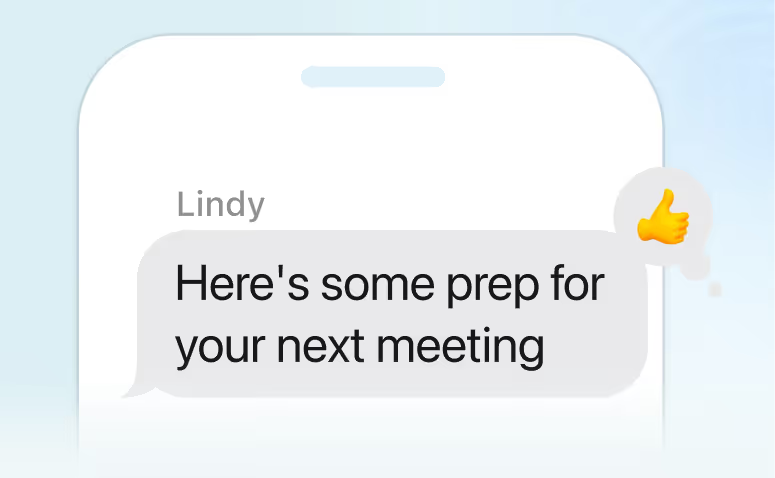
Pick the narrowest use case, run it for thirty days, and measure what you saved. Many small teams and founders start with Lindy. It's an AI assistant you text, and it connects to hundreds of apps without any setup.
{{cta}}
Why Lindy is where most teams start
AI employees can get overwhelmed fast. Platforms pile up, setup drags on, and the admin work is still sitting there. Many founders and small teams reach for Lindy instead. You text it what you need, and it handles it. No complicated setup required.
Whether it’s managing your inbox, scheduling meetings, updating your CRM, or following up with leads, Lindy handles it.
Here’s what that looks like in practice:
- Get answers instantly: Text Lindy to pull information from your email, calendar, or CRM without digging through tabs.
- Send emails and follow-ups automatically: Ask Lindy to draft, personalize, and send outreach and handle replies.
- Take meeting notes and share summaries: Lindy joins meetings, writes structured notes, and follows up afterward.
- Update your CRM without manual entry: After a call, Lindy logs notes and automatically fills in missing fields.
- Find and qualify leads in minutes: Tell Lindy your ideal customer profile and get curated lead lists ready for outreach.
- Hundreds of app integrations: Lindy connects with the tools you already use, so everything stays in sync.
FAQs
How is an AI employee different from a chatbot?
An AI employee is fundamentally different from a chatbot in one way: it acts without being asked. A chatbot responds when you prompt it. An AI employee monitors your tools, waits for something to happen, and takes action on its own. It drafts, sends, books, logs, and escalates without you having to initiate every step.
Can a small business afford an AI employee?
Yes, small businesses can afford an AI employee. Most platforms start between $20 and $200 per month. If your team is spending two to three hours daily on repetitive tasks like inbox management, follow-ups, or CRM updates, the math works quickly. Start with one use case, measure the time saved, then expand.
Do AI employees replace human workers?
No, AI employees don't replace human workers. They replace specific categories of repetitive work. Mainly, tasks that slow people down but don't need real judgment. Your team gets freed up for higher-value work instead of being let go. Most businesses that adopt AI employees add capacity without cutting headcount.
How long does it take to set up an AI employee?
Setup time for an AI employee varies by platform and use case. Simpler platforms with plain-English instructions are running in under ten minutes. Workflow-heavy platforms can take hours. The general rule: the more you have to configure upfront, the longer it takes to see results. Start simple and build from there.
What happens when an AI employee makes a mistake?
When an AI employee makes a mistake, the best platforms give you controls to catch it before it causes damage. Start with human-in-the-loop approval on anything customer-facing. Most teams trust the output fully within two to three weeks once they've seen the quality firsthand and adjusted their guardrails accordingly.
Can an AI employee work across multiple functions?
Yes, some AI employee platforms work across multiple functions from a single interface. Others are purpose-built for a single job, such as sales or support. If you need a single tool that covers inbox, calendar, CRM, and customer support without switching between platforms, look for a multifunctional assistant built around a single place to interact.










Blog
Related Articles
%20(1).png)

.avif)
%2520(1).avif)

.png)
.png)

The AI assistant that runs your work life
Lindy saves you two hours a day by proactively managing your inbox, meetings, and calendar, so you can focus on what actually matters.
