


Agentforce Review 2026: Everything You Need to Know


I spent weeks testing Agentforce across Salesforce workflows to understand how it helps you manage complex data and automate business workflows. Here’s a clear breakdown of how it works, its costs, and when it’s worth choosing over other AI agent platforms.
What is Agentforce?
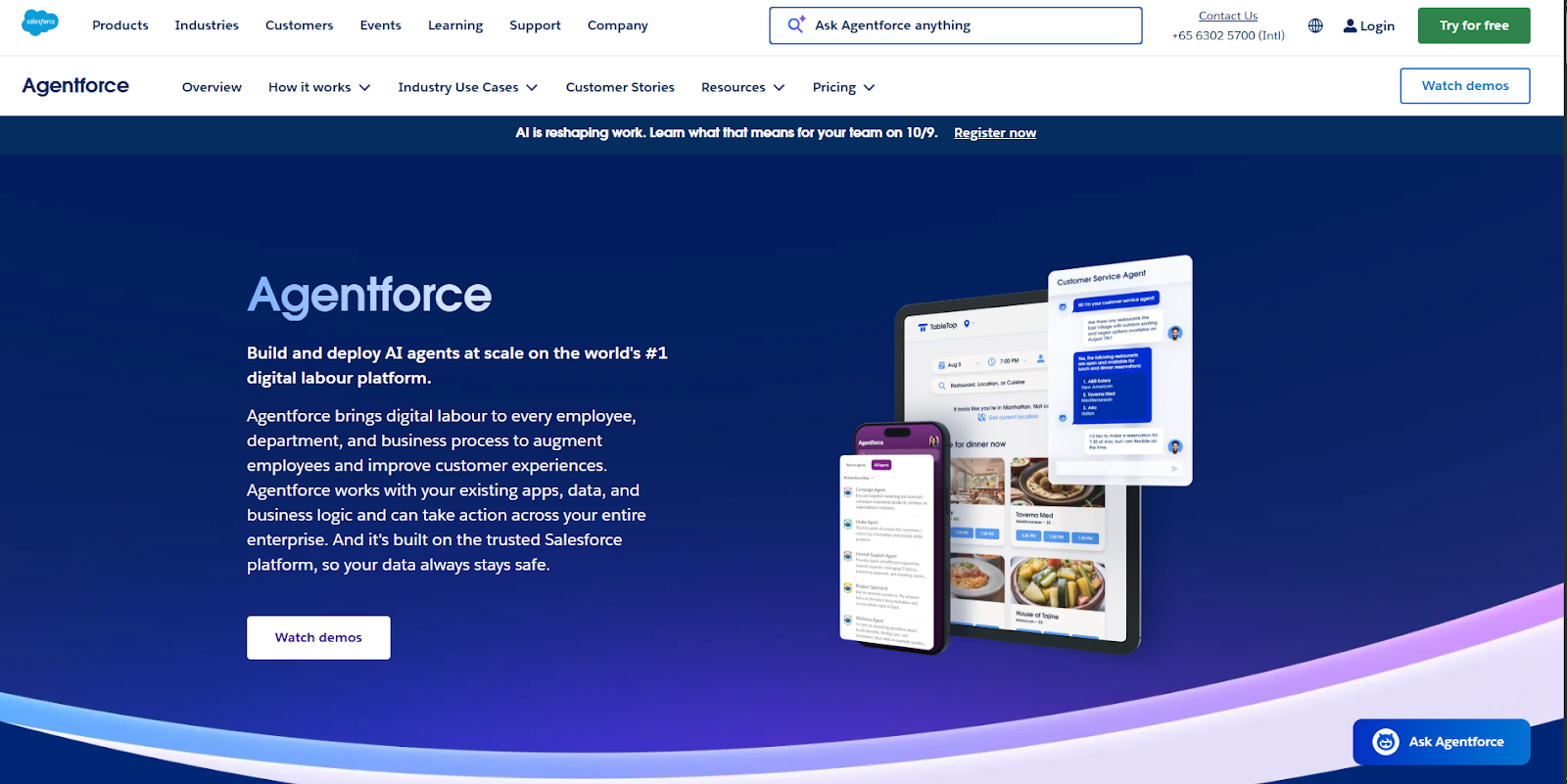
Agentforce is Salesforce’s AI agent platform that helps teams automate service and sales tasks. It builds on CRM and Data Cloud data to let agents understand requests, decide on actions, and complete tasks inside Salesforce or connected systems.
Businesses use it to replace manual steps like case updates or appointment scheduling with guided, auditable automation.
Agentforce is a part of the Salesforce ecosystem and acts as an autonomous AI agent tool. It works alongside Agentforce Assistant (formerly Einstein Copilot).
Agentforce Assistant handles in-app, quick-task help for employees, while Agentforce runs the heavier, autonomous workflows across Salesforce and connected systems. Together, they give teams conversational support with end-to-end automation under one platform.
Key features
Agentforce lets companies design and run AI agents within Salesforce. The platform combines reasoning, automation, and governance so teams can handle customer requests or sales tasks without switching tools.
Here are the main features to know:
- Atlas Reasoning Engine: Plans and executes multi-step workflows.
- Agent Builder: Connects actions through Flows, MuleSoft, APIs, or Apex.
- Command Center: Monitors live agents and their performance.
- Guardrails and trust layer: Add security, data masking, and compliance controls.
- Digital Wallet: Tracks Agentforce usage in real time.
- Prebuilt agents: Templates like SDR, Service, and Sales Coach that help teams launch faster.
These features help Agentforce automate everyday workflows within Salesforce. Let’s see how.
How does Agentforce work?
Agentforce works by connecting user requests with Salesforce data and automating actions. Here’s how the process looks:
- A user enters a request in Salesforce or a connected channel.
- The Atlas reasoning engine interprets intent and maps it to a defined topic.
- The agent enters the response in CRM or Data Cloud records.
- Actions run through Flows, APIs, MuleSoft, or Apex to complete the task.
- Admins test and monitor results in the Command Center.
For example, a support agent receives a request to update a case. Agentforce verifies the customer, retrieves the case, and adds a comment automatically. That flow uses three actions, which Salesforce estimates at about 60 credits, or $0.30, under the Flex pricing model.
It’s different from Agentforce Assistant because it can work across different Salesforce apps. Let’s explore a few more differences.
{{templates}}
Agentforce vs Salesforce Copilot: What’s the difference?
Agentforce is not the same as Copilot. Both work inside Salesforce, but they do different things. Here’s a side-by-side comparison:
Both tools can complement each other. Copilot focuses on in-app productivity, while Agentforce executes autonomous workflows.
What I liked and didn’t like about Agentforce
Agentforce works well for teams that use Salesforce, but there are some pain points. Here’s a detailed breakdown of pros and cons:
What works
- Deep CRM integration: Agents act directly on Salesforce records, which improves accuracy on structured data.
- Lifecycle tooling: Agent Builder, Testing Center, and Command Center let admins design, validate, and monitor agents in one place.
- Automation speed: Agents can execute multi-step workflows faster than manual processes, saving time in service and sales.
- Interoperability: Model Context Protocol (MCP) and AgentExchange extend actions to external tools, giving Agentforce more reach.
Where it falls short
- Learning curve: Effective use requires admin and developer expertise, along with clean data.
- Salesforce lock-in: The platform delivers the best value when you’ve already invested in Salesforce.
- Pricing complexity: The choice between Conversations, Flex, or per-user editions makes it harder to estimate Agentforce cost.
- Maturity: Some reviews question the stability and whether it suits smaller teams.
Is Agentforce worth it? My take
Agentforce is worth it if you’re an enterprise team who already runs Salesforce. With large datasets and structured workflows, the platform will help you reduce handling time, improve service outcomes, and scale digital labor.
For SMBs or companies not using Salesforce, it may not be worth it. Setup demands, pricing complexity, and the need for clean data are the barriers you’ll have to overcome. In those cases, you’ll be better off with some of its alternatives.
Agentforce is perfect for
- Enterprise sales and service teams already using Salesforce.
- Companies with good quality CRM data and large-scale workflows.
- Organizations investing in an end-to-end Salesforce ecosystem with Data Cloud and Flows.
Skip Agentforce if you
- Need lightweight, flexible AI agents across multiple tools.
- Want predictable, lower-cost pricing without credits or add-ons.
- Prefer standalone options with faster adoption outside Salesforce.
If Agentforce is for you, let’s see how you can set it up easily.
How to set up Agentforce
Agentforce, like every other tool, works best when you set it up right. Here are the five steps to follow:
- Confirm Salesforce environment compatibility: Check editions, sandboxes, and whether you’ll use Conversations or Flex Credits, as you cannot run both at the same time.
- Request access or trial from Salesforce: Talk with your account executive to get the right add-ons or editions.
- Enable Agentforce in your organization: Activate Agent Builder, assign roles, and set guidelines for safe use.
- Train on historical CRM data: Connect Salesforce records or Data Cloud objects to train agents for your workflows.
- Deploy to one team: Start with one pilot use case, like AI for sales, and monitor results in the Command Center.
This helps you monitor the KPIs and refine workflows.
Best practices for using Agentforce effectively
Once your setup works without hiccups, you must optimize it to get the most out of it.
These habits will give you the best results:
- Prioritize data hygiene: Keep CRM and Data Cloud records clean to avoid poor responses.
- Roll out in phases: Pilot one use case, validate results, and then expand.
- Train users and admins: Teach your staff how to trigger, monitor, and refine agents.
- Track ROI: Use the Digital Wallet to measure your total cost against savings.
It’s easy to make a few mistakes while optimizing. Here are the ones to avoid:
- Automating without a clear escalation path for human review.
- Not monitoring in the Command Center after deployment.
- Ignoring hidden costs like Data Cloud credits.
Agentforce is powerful, but it works best within the Salesforce ecosystem. If you’re not willing to commit, look for other AI agent tools.
Agentforce vs other AI agent tools
Tools like Lindy, n8n, and CrewAI also let you create AI agents to automate your tasks. I compared them side-by-side to show you where each tool stands:
Agentforce is perfect for users already using Salesforce. Lindy works best for non-technical teams who want easy setup and quick automation. n8n appeals to technical teams who can tinker with code to create custom workflows, while CrewAI suits developers who want complete control over their AI agents.
My verdict on Agentforce
Agentforce is ideal for enterprises that already use Salesforce. It combines CRM integration, lifecycle management, and governance that smaller platforms cannot match. If you have clean, structured data and resources to manage the setup, Agentforce makes absolute sense for automation.
However, small businesses or teams outside Salesforce will face higher costs and a complex setup before they see ROI. In these cases, tools like Lindy, CrewAI, or n8n offer better value at lower prices.
Try Lindy to automate tasks across sales, CRM, and support
Lindy is an AI automation platform and a strong alternative to Agentforce for teams that aren’t locked into the Salesforce ecosystem. It lets you build custom AI agents for tasks like email triage, lead generation, document parsing, and more.
You can get started in minutes using the pre-built templates and 4,000+ integrations.
Lindy helps automate your workflows with features like:
- Drag-and-drop workflow builder for non-coders: You don’t need any technical skills to build workflows with Lindy. It offers a drag-and-drop visual workflow builder.
- Create AI agents for your use cases: You can give them instructions in everyday language and automate repetitive tasks. For instance, create an assistant to find leads from websites and sources like People Data Labs.
- Personalized email outreach and replies: Lindy’s Lead Outreacher crafts personalized outreach and manages replies autonomously. Your team can send professional replies without hours of manual effort.
- Update CRM fields without manual entry: Instead of just logging a transcript, you can set up Lindy to update CRM fields and fill in missing data in Salesforce and HubSpot without manual input.
- Send follow-up emails and keep everyone in sync: Lindy agents can send follow-up emails, schedule meetings, and keep everyone in the loop with a Slackbot.
- Supports tasks across different workflows: Lindy handles meeting notes, website chat, lead generation, and content creation. You can create AI agents that help reduce manual work in training, content, and CRM updates.
- Cost-effective: Automate up to 40 monthly tasks with Lindy’s free version. The paid version lets you automate up to 1,500 tasks per month, which is a more affordable price per automation compared to many other platforms.
Try Lindy free and automate up to 40 tasks with your first workflow.
{{cta}}
Frequently asked questions
How much does Agentforce cost?
Agentforce costs $2/conversations or $0.10 per action, depending on whether you choose the Conversations pricing model or Flex Credits pricing model.
Flex Credits cost $500 for 100,000 credits, while the add-ons cost $125 per user per month, with an industry add-on at $150. Full editions start at $550 per user per month.
What are the main features of Agentforce?
Atlas reasoning engine, Agent Builder, Flows and MuleSoft actions, the Command Center for monitoring, and pre-built agents like SDR and Service are some of the main features of Agentforce.
Is Agentforce the same as Copilot?
No, Agentforce is not the same as Copilot. Agentforce is the platform for building autonomous AI agents. Copilot, now called Agentforce Assistant, is the in-app helper for quick employee tasks inside Salesforce.
What are the pros of Agentforce?
Strong Salesforce integration, governance, and observability are some of the pros of Agentforce.
What are the cons of Agentforce?
Its steep learning curve, Salesforce lock-in, and complex pricing are some of the cons of Agentforce. Many teams also struggle to model costs, which makes budgeting harder.
Is Agentforce profitable?
Agentforce is profitable for large enterprises with structured CRM data. Smaller teams face setup costs and usage fees that make profitability harder to achieve.
What is the best alternative to Agentforce?
Lindy, CrewAI, and n8n are some of the best alternatives to Agentforce. Lindy is a no-code option that works across CRMs, email, phone, and Slack. n8n is an open-source, developer-focused AI agent platform. CrewAI supports multi-agent systems for technical teams.







Blog
Related Articles
%20(1).png)
%20(1).png)

%2520(1).png)
The AI assistant that runs your work life
Lindy saves you two hours a day by proactively managing your inbox, meetings, and calendar, so you can focus on what actually matters.
